Frequently Asked Questions
- What does it mean that Black Pine Animal Sanctuary is accredited by GFAS?
Only 200 sanctuaries worldwide have achieved accreditation by the Global Federation of Animal Sanctuaries (GFAS), a lengthy and thorough process that assures the public that the animal residents are cared for with the highest standards for their health and well-being for the rest of their lives. We are the only the only GFAS sanctuary located in the Midwest and proudly hold ourselves to their high standards.
- What is the difference between a sanctuary and a zoo?
Black Pine Animal Sanctuary is a true sanctuary where the animals are not bought, bred, sold, or traded. They are surrendered or confiscated due to neglect or illegal possession, and they are carefully cared for at a sanctuary for the rest of their lives. At Black Pine, the staff and volunteers provide refuge, excellent care, and a forever retirement home for the animals. Our residents roam freely in their habitat and interact with guests on their own terms.
- How many animals live here?
Typically, around 80 animals are in residence at the Sanctuary.
- Can people pet the animals at Black Pine Animal Sanctuary?
No. The animal residents live at Black Pine Animal Sanctuary for refuge and a safe and caring environment. Interaction with humans can be frightening and disruptive to wild and exotic animals. It is also dangerous both for the visitor and the animal. The only human interaction sanctuary residents have is with the highly skilled keepers who provide care, enrichment, and medical treatment for the animal’s well-being.
- Can Black Pine Animal Sanctuary care for injured or abandoned animals?
At Black Pine Animal Sanctuary, we have a team that reviews inquiries regarding bringing an exotic animal into the sanctuary. If you have or know of a captive-raised exotic animal in need of refuge, please fill out the form or complete the PDF and email it to exec@blackpine.org.
After review, the team will contact you with further information as soon as possible. At present, we are not able to accept grazing/farm animals, aquatic animals, ground birds, or native-born Indiana wildlife.
To help native-born wild animals, please contact the Indiana Department of Natural Resources (DNR), as Black Pine Animal Sanctuary is not licensed or equipped to do so.
Please contact your local humane society or shelter organization for assistance with domestic and pocket pets, such as dogs, cats, rabbits, guinea pigs, rodents, hedgehogs, chinchillas, and ferrets.
- Can I take photographs?
Yes, but please turn your flash off! And, tag us on social media!
- How is Black Pine Animal Sanctuary funded?
Black Pine Animal Sanctuary is a 501[c] 3, which means we are a public non-profit. Fundraising events, private donations, and grants provide care for the animal residents. Most of the funding comes from grassroots donations from people and companies who share our mission of caring for the animal residents and raising awareness about their plight. Please visit our help section for the many ways you can help with Black Pine’s mission.
- How many people visit each year?
Approximately 20,000.
- Can I arrange a field trip or group visit to Black Pine Animal Sanctuary?
Education is an integral part of the Black Pine Animal Sanctuary’s mission. We offer field trips for schools and groups from April through October. To schedule a meeting, please email info@blackpine.org or call (260) 636-7383 for assistance.
- Do I need a reservation to visit?
Reservations are not necessary for general visitation, which is available Friday & Saturday 1:00 p.m. to 4:00 p.m. from the first weekend of May until the last weekend of October. We recommend booking a tour on our website to ensure availability.
Please note that reservations are required for our exclusive Behind the Scenes, Enrichment Feeding, and the Toddlers & Tots tour. These unique experiences can be reserved here.
- What types of payment do you accept?
We accept cash, check, Pay Pal, or all major credit cards (Visa, MasterCard, and Discover). Visitation and donation checks may be written out to Black Pine Animal Sanctuary.
- Is the Sanctuary open when it’s raining?
Yes. We are open during the regular season during the rain and close only for lightning, high winds, steady heavy rain, or dangerous weather. Prepaid reservations are subject to our cancellation policy.
- Where do the animals go in the winter?
All residents are permanent residents and they are managed following the same guidelines and best practices as any zoological institution that houses similar animals.
- The large cats are able to stay outside unless temperatures go below zero. The African serval and our Savannah cat have an indoor area and stay inside when it is below freezing.
- The primates may be outside, varying by species, from 32-65°F.
- The birds can go outside, varying by individual, from 60-70°F .
- The reptiles can go outside around 70°F and above.
- Is the Sanctuary accessible for wheelchairs, strollers, walkers and wagons?
Yes. The visitor parking area and the sanctuary are paved. We also have wheelchairs available for guests as needed.
- Is food available at the Sanctuary?
The sanctuary gift shop Wolf Den Gifts and Things offers cold bottled drinks. Guests are welcome to bring a picnic and enjoy the covered pavilion with picnic tables on a first-come, first-served basis. Sanctuary rules prohibit alcohol and smoking.
- Are pets allowed in the Sanctuary?
No. This is for the safety of your pet and the animal residents, who may become aggressive or agitated by visiting domestic pets.
- What else is there to do near Black Pine Animal Sanctuary?
Black Pine is in the heart of Noble County, with various options for outdoor enthusiasts, history buffs, art lovers, and more! Chain-of-Lakes State Park is just miles away. Albion offers several locally-owned restaurants and shops, including a coffee shop, Gastropub, and a pizzeria. For more information, check out www.visitnoblecounty.org.
- What is your cancellation policy?
All pre-purchased programs are non-refundable unless Black Pine cancels for any reason. In that case, the buyer is eligible for a full refund or credit towards an alternative program, date, and/or time. Refunds, when applicable, will be made within 7-10 working days.
All pre-purchased program reservations are transferable. Please present program acknowledgment, confirmation, or receipt upon arrival to redeem. All other program restrictions apply as noted.
For a request to change or transfer credit to another program date or time, you must receive confirmation from sanctuary staff must be confirmed more than 24 hours before the initially purchased program date/time to be eligible for credit. Make change requests by calling (260) 636-7383 or emailing info@blackpine.org. Proof of purchase may be required. A program change fee may apply under extraordinary circumstances. Changes may be limited to use within one year of the original purchase date. Please call 260-636-7383 to cancel if you are unable to attend. Volunteers often drive long distances to accommodate these programs, so advanced notice is required. No-call or no-shows may be subject to cancellation fees. If a situation arises and Black Pine cancels a prepaid program for any reason. In that case, the sanctuary will issue a 100% refund and notify participants.
- What can you tell me about the cemetery?
Because our residents are here until the day that they pass, whether it is naturally or through humane euthanization, we have a cemetery on the grounds to memorialize them. At this time, staff and volunteers escort guests into the cemetery if they are interested in paying respects (due to safety and insurance concerns). The existing crosses were initially placed when the animals were physically buried here, but we now use a marble plaque for each resident.
- Do you accept meat or food donations?
Livestock:
Due to the Avian flu, we cannot accept farm-fresh eggs or poultry at this time. We do not accept meat from horse, pig, sheep, lamb, or goat. We do not accept live animals, sick animals, or chemically euthanized animals. Cows must be pre-butchered.
Deer:
We cannot accept any deer donations at this time due to the presence of CWD in the area.
Freezer Meat:
We cannot accept lunchmeat, pork, sausage, or smoked/marinated/seasoned meats. We do not feed out meat that is older than two years old, freezer burnt, or meat that has been thawed and refrozen. We can only accept freezer meat that is in human-grade, store bought or butcher packaging. No tinfoil, ziplock, or vacuum sealed packages, please. Best by or packaged dates must be printed on packaging, and packaging cannot be broken.
Frozen Produce:
We can accept frozen produce as long as it is not expired, freezer burnt, and has no added sugar, seasonings, or other additives.
- How much meat do the cats eat and how often are they fed? Where do you get your meat?
Small cats = 12-16 oz./daily; Medium cats = approx. 3 lbs./daily; Large cats = 8-16 lbs./daily, depending on their age, activity level, body condition score, and any medical issues they may be having. In the summer, the large carnivores are fasted once/weekly due to the heat and decreased energy levels (mimics a more natural digestion). This comes to an average of 650 pounds of raw meat fed out weekly!
We receive donations from the Walmart Distribution Center and Costco on a weekly basis, in addition to personal meat donations.
- What do the primates eat?
All of our primates and small mammals are provided fresh produce, protein, and commercial zoo biscuits.
- Where does your produce come from?
The Walmart Distribution Center donates food twice a week and Costco in Fort Wayne donates several pallets of food every week. Volunteers are scheduled to go to pick up these donations. We order produce weekly, and in 2024 we received a grant to start our garden and become more self-sustainable.
- Is there a veterinarian on staff?
We have a veterinary technician on staff, and an animal curator with veterinary technician experience. However, we do not have a veterinarian on staff. We obtain services of both trained exotic veterinarians and local large and small animal veterinary clinics. We pay for veterinary services, supplies and medications, so your donations are crucial to saving lives!
- What is a stereotypic behavior?
Animal Welfare Institute defines it as, “repetitive, invariant behavior pattern with no obvious goal or function.” Examples of these behaviors in our residents are pacing/ head tossing Cinny, head rolling in Tucker, plucking in Sammy, etc. Many of our residents came to us exhibiting these behaviors on a frequent basis. Through individualized welfare plans which include spacious, species appropriate habitats, appropriate diet and vet care, daily enrichment, and species appropriate companionship, our residents still bare signs of their former traumas, but we are able to greatly reduce the frequency of the behaviors and give our residents a high quality of life. For some, their experience at BPAS results in total elimination of these behaviors, for others the mental and emotional scars run so deep, that a decrease in frequency is all we can ask for.
- Why do the habitats have toys and “garbage” (boxes, paper, etc.)?
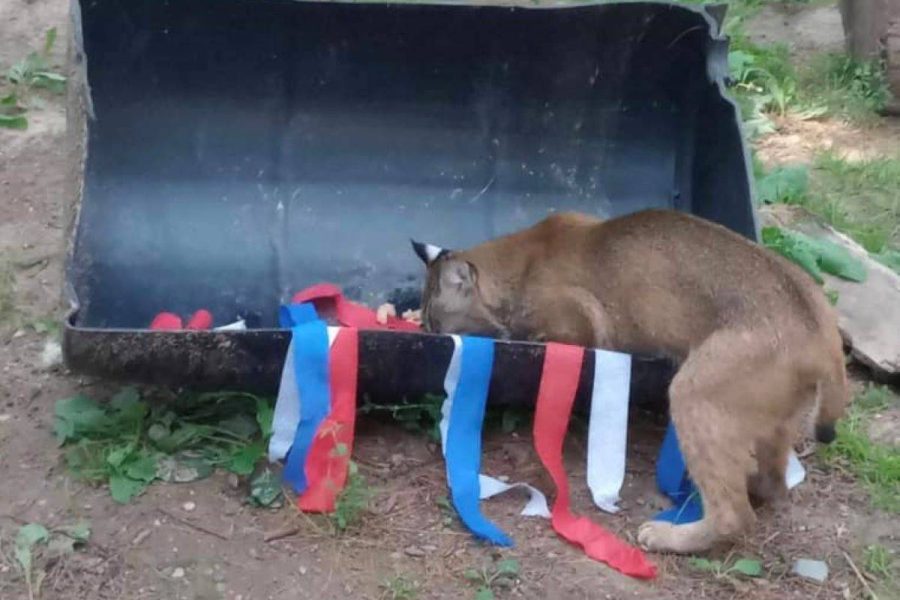
Enrichment is anything that the keepers provide the animals that encourages natural behaviors and keeps their brains active. The toys, boxes, and anything else you see in the habitats are used for hiding their food and encouraging foraging behaviors. They do not use these toys like children would, but it provides a source of entertainment for them.
These are wild animals whose surroundings and environments would be ever-changing and they would have to hunt, forage, or track-down their food and water sources. Additionally, these animals have come from circumstances where they were often denied the ability to exhibit their natural behaviors, causing mental traumas and stereotypies to develop, which increases their enrichment requirements.
- Has an animal ever escaped?
Animal escapes happen in every captive population, even in the best facilities. Human error or uncontrollable circumstances, such as severe weather, are nearly always to blame. BPAS’ few incidents over the years have never resulted in injury to humans or animals, but accidents have happened. The sanctuary’s emergency dangerous animal escape protocol has been deployed with very good results. Several paid keepers and long-time volunteers (including past employees) are trained in chemical immobilization, as well as use of firearms, to respond in the event of an emergency. Equipment is maintained on premises to capture, restrain, sedate, and if necessary, take down animals if they pose a risk to human life.
- What is the difference between New World Monkeys and Old World Monkeys?
“Old World” monkeys are native to Africa and Asia. They are medium to large-sized with no prehensile tail, more intelligent, have trichromatic vision (see in color), their nostrils are together and open downward or forward, and they have cheek pouches. Their thumbs are rotated and more opposable and they have a butt pad for sitting and attracting mates. Includes Baboons, Guenons, Macaques, Vervets, Mangabeys, Patas, Colobus, Langurs, Leaf Monkeys, Mandrills, and Proboscis.
“New World” monkeys are native to Mexico, Central and South America. They are arboreal (live mostly in trees), are small to medium-sized with a prehensile tail (use as another appendage), less intelligent, lack trichromatic vision (do NOT see in color), have a flat nose and their nostrils are farther apart and open to the side. They do NOT have cheek pouches, their thumb orientation lies in line with other digits, and they do not have a butt pad. Includes Marmosets, Tamarins, Howler Monkeys, Spider Monkeys, Woollys, Titi monkeys, Capuchins, Squirrel Monkeys, Owl Monkeys, Sakis, and Uakaris.
- What is the difference between New World Parrots and Old World Parrots?
“Old World” parrots are afrotropical, referring to the Eastern hemisphere, Africa, Europe, Asia and Australia. They originate from more arid habitats that are susceptible to drought-like conditions. Includes African Grey Parrot, Cockatoos, Senegal Parrot and Cockatiels.
“New World” parrots are neotropical, referring to the Western hemisphere, namely the Americas. They originate from rainforest-type habitats. Includes Amazon Parrots, Macaws, Caiques, Conures and Parakeets.